
If your main reference for what a therapist does comes from television, movies, or a funny skit on social media, you’re not alone. Pop culture has offered us everything from the deeply analytical Freudian archetypes to therapists who act more like quirky best friends. But while those portrayals may capture the drama of therapy, they often miss the quiet power, complexity, and human connection that truly defines the work.
So what does a therapist actually do? And what might it be like to sit in a room (or on a video call) and talk to one?
Whether you’re considering therapy for the first time, exploring support for a friend or loved one, or just curious to learn more, this post offers a deeper, real-world look free from stereotypes and judgment.
Therapy At Its Core
Therapy is about understanding. It’s about finding patterns, untangling emotions, identifying wounds, and building tools to help you live with more clarity, resilience, and self-awareness. A therapist isn’t just someone who listens (though they do that well); they’re someone trained to listen differently.
Licensed therapists are trained mental health professionals who use evidence-based techniques to help clients process emotions, challenge distorted thinking patterns, and develop healthier coping strategies. They create a space where you can speak honestly—sometimes for the first time—and not be met with judgment, but with thoughtfulness and care.
At Oakwood Counseling, our therapists bring clinical expertise, compassion, and respect to every session, tailoring our approach to your needs, goals, and pace.
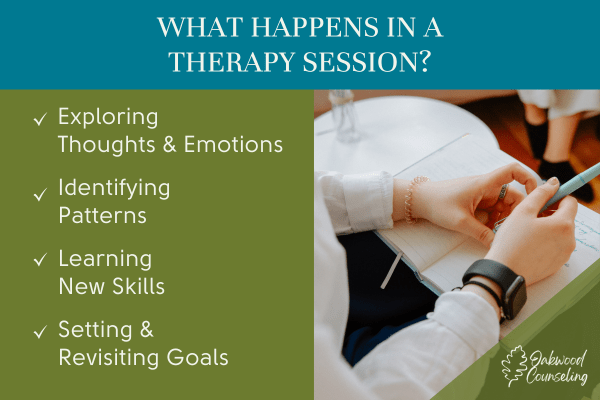
What Happens in a Therapy Session?
A first therapy session is often a mix of getting to know each other and gathering context. Your therapist might ask questions about what brings you in, your current challenges, your history, and what you hope to get out of therapy. It’s a collaborative conversation—not an interrogation.
Over time, therapy may involve:
- Exploring Thoughts and Emotions: You’ll be encouraged to examine what you’re feeling and why, often discovering connections you hadn’t noticed before.
- Identifying Patterns: Therapists are trained to spot emotional or behavioral patterns—especially those that may be causing distress or getting in the way of growth.
- Learning New Skills: Therapy isn’t just reflective; it’s practical. You might learn tools for managing anxiety, setting boundaries, improving relationships, or navigating grief.
- Setting and Revisiting Goals: Therapy can evolve as your needs do. A good therapist will work with you to set goals and revisit them regularly.
While there might be some people who can have one session and leave with a clear, new outlook on life, most of the time therapy offer instant solutions or quick fixes. It’s a process—sometimes slow, sometimes surprising, but often transformative.
Debunking Common Myths
If you’ve never seen a therapist before, it’s normal to have some misconceptions. Let’s address a few of the most common:
- “Therapy is only for people with serious problems.”
Therapy can be life-changing for those facing crisis, but it’s just as valuable for people dealing with everyday stress, relationship challenges, self-doubt, or life transitions. You don’t have to be in an ongoing crisis to benefit. - “Therapists just tell you what to do.”
In reality, a therapist’s role is not to give advice, but to help you gain insight and develop your own clarity and confidence. - “Talking about the past won’t help me now.”
While not all therapy is focused on the past, understanding your history can often illuminate why certain patterns show up in the present—and how to shift them. - “If I start therapy, I’ll need it forever.”
Many people attend therapy for a few months or a year, while others choose to continue long-term. It’s flexible, and ultimately, it’s your decision how long you continue.
Different Types of Therapists and Approaches
Just as no two clients are alike, neither are therapists. At Oakwood Counseling, we offer a range of approaches to match different needs:
- Cognitive Behavioral Therapy (CBT): Focuses on identifying and changing unhelpful thought patterns.
- Psychodynamic Therapy: Explores deeper emotional experiences and unconscious influences from the past.
- Person-Centered Therapy: Offers a non-directive, supportive space to explore your feelings at your own pace.
- Family and Couples Therapy: Helps strengthen communication and understanding in relationships.
- Trauma-Informed Therapy: Designed for those recovering from trauma, offering sensitivity and safety.
No matter the method, the relationship between client and therapist is the foundation. You should feel safe, seen, and supported.
Finding the Right Therapist for You
Choosing a therapist is personal—and the right fit matters. It’s okay to ask questions. It’s okay to try a session or two before committing. We encourage clients to find someone they connect with, whether it’s one of our experienced team members or another trusted professional.
If you’re nervous, that’s normal. If you’re skeptical, that’s welcome. You don’t have to show up with everything figured out—you just have to show up.

Strength Through Therapy
Therapy isn’t about weakness. It’s about strength—the quiet kind. The kind that comes from facing what’s hard, showing up consistently, and choosing growth over avoidance. It’s not always easy, but it’s always worth it.
If you’ve ever wondered whether talking to a therapist could help, we invite you to find out.
Oakwood Counseling believes in meeting people where they are—with compassion, professionalism, and hope. Whether you’re managing anxiety, exploring identity, navigating grief, or just looking for someone to talk to, we’re here for you.
Because no one should have to figure it all out alone.
Ready to take the next step? Schedule an appointment today and see what’s possible when you give yourself the space to grow—with a therapist who’s ready to walk beside you.