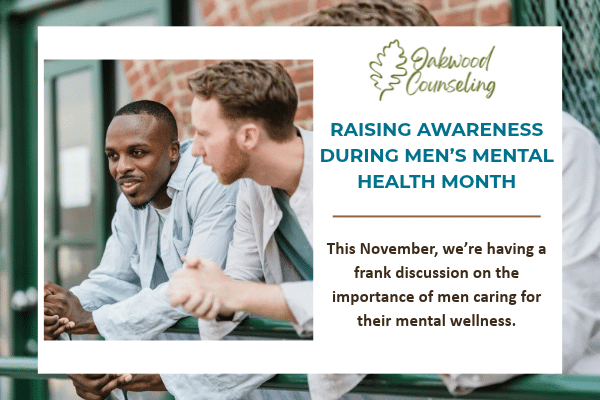
November is Men’s Mental Health Awareness Month, a good time to have a frank discussion on the importance of caring for your mental wellness. Because the harsh truth is, the numbers on men’s mental health are concerning, and they don’t have to be.
This blog isn’t meant to be a lecture. It’s not another article telling you to “open up” without explaining what that means or why it’s harder than it sounds. If you’re a man who’s been carrying something heavy – stress, anger management, a sense that something’s off – we ask you to keep reading, and find hope.
What the Numbers Say
More than 6 million American men experience depression each year, and nearly 1 in 10 experiences co-occurring anxiety. Men die by suicide at roughly four times the rate of women, and about 60% of men who die by suicide had no documented mental health condition before their death. This doesn’t mean that they weren’t struggling. It means they weren’t in treatment, may not have known they were struggling, or didn’t feel like they could say so.
Despite this, men are significantly less likely than women to seek help. Only around 41% of men with a mental health condition receive treatment, compared to roughly 57% of women. And according to research, men wait an average of 11 years before seeking help for symptoms they’re already experiencing.
11 years is a long time to be suffering alone.
Why Men Don’t Get Help (And Why That Logic Makes Sense, Until It Doesn’t)
It’s worth being honest about why men avoid therapy, because dismissing those reasons can be more damaging than helpful. Research identifies several consistent barriers to mental health, including social stigma, discomfort expressing emotions, a preference for handling things alone, and fear of being judged. For some men, there’s also a concern that admitting struggle could affect how they’re perceived at work, in their relationships, or within their communities.
These aren’t irrational fears. They’re shaped by decades of stigma and messaging that told men strength means silence. But the truth is, research also shows that men who get support don’t become weaker. Instead, they function better throughout their entire life, as partners, as fathers, and as people.
A 2023 study found that men are more likely to seek help when a trusted person in their life encourages it or when symptoms start visibly affecting their functioning. The problem is that waiting until you’re visibly failing can come with a high cost.
What Depression and Anxiety in Men Look Like
One reason men often go undiagnosed and untreated is that male depression doesn’t always look like the textbook version. Men are more likely to show depression through irritability, anger, increased risk-taking, or withdrawal rather than visible sadness. If you’ve been snapping at people more than usual, feeling numb, losing interest in things you used to care about, or drinking more to cope, those are signs that matter.
The same is true of anxiety. Anxiety in men often presents as restlessness, difficulty concentrating, physical tension, or a constant sense of being on edge, not necessarily the worrying and panic that anxiety is often associated with in popular culture.
What Therapy for Men Looks Like
Therapy isn’t lying on a couch and talking about your childhood for fifty minutes while someone nods. That’s a caricature from a different era. Modern therapy, especially the kind that tends to work well for men, is collaborative, goal-oriented, and practical.
You identify what’s not working. You build skills to address it. All while you have a professional in your corner who’s not going to judge you, report back to your partner, or tell you what you should feel. Good therapists for men know how to work with how men are wired, getting into problem-solving mode, building on strengths, and moving toward something concrete.
Therapy approaches specifically adapted for men, including those that emphasize emotional competency, agency, and strengths, have shown strong outcomes. The evidence is there. The barrier isn’t effectiveness; it’s access and the willingness to try.
The Movember Connection
Movember started as a campaign to grow mustaches and raise awareness for prostate cancer. Over time, it expanded to encompass men’s mental health, specifically for suicide prevention. The core message is simple: men’s lives matter, men’s health matters, and the silence around men’s struggles is costing lives.
You don’t have to grow a mustache to take it seriously. But if November gets you thinking about men’s mental health, that’s worth something.
Oakwood Counseling Is Here for Men
At Oakwood Counseling, we offer individual counseling for adults in Bryan, serving the Brazos Valley, including men who are dealing with stress, anxiety, depression, anger, relationship struggles, career pressure, or a general sense that something isn’t right. We also offer virtual sessions anywhere in Texas, which means you don’t have to come into an office if that feels like too much of a step right now.
You don’t need to be in crisis to schedule a session. You just have to decide that carrying it alone isn’t working anymore. Take the first step by scheduling an appointment for men’s mental health with Oakwood Counseling or calling (979) 229-7636.
—–
Sources:
Seattle Neurocounseling
KTVZ/Stacker
Mental Health Stigma and Men’s Treatment Gaps (2024)
GoodTherapy
Preprints.org
Men’s Mental Health Barriers Research
Frequently Asked Questions
How long is each counseling session?
The standard session is 50 minutes, but we can adjust that for more or less time depending on your needs.
How often should I attend therapy?
Most begin with weekly sessions, but the frequency of your sessions is a decision you make in consultation with your therapist.
Do I need a diagnosis to start therapy?
No. You can start therapy anytime.
Contact Oakwood Counseling – College Station & Bryan, TX
Website: https://www.oakwoodcounseling.com/
Phone: (979) 229 7636
Location:1100 Briarcrest Dr Bryan, Texas 77802
Schedule your evaluation today.