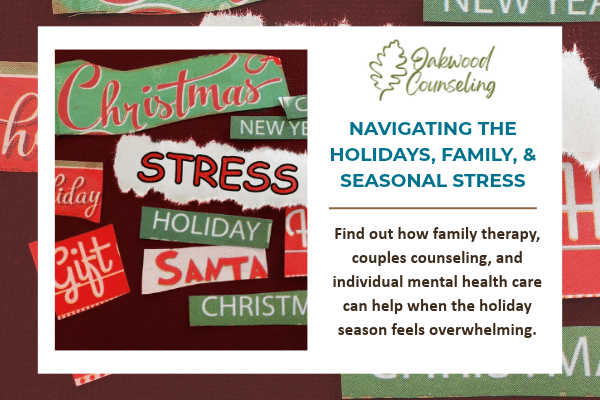
The holidays are supposed to be the best time of year. For many families, they are genuinely a time full of warmth, tradition, and connection. But for others, Thanksgiving through New Year’s feels less like a season of joy and more like a test, navigating complicated family dynamics, old wounds that never healed, and social obligations made harder by private struggles.
If that sounds familiar, know that you don’t have to wait until you’re in the thick of it to get support. Options like family therapy, couples counseling, and individual mental health care can make a big difference when “the best time of year” feels more like the worst.
During the Holidays, Relationships Are Put Under a Microscope
The holiday season compresses everything. People who rarely see each other suddenly spend days together in close quarters. Financial stress spikes due to so many costs all at once. Sleep schedules get disrupted, while children are overstimulated. Partners who’ve been managing conflict by staying busy suddenly have nowhere to hide from it.
For families already carrying unresolved tension, whether between partners, parents and children, or within blended families navigating complex dynamics, the holidays can be a pressure cooker. What felt manageable in September may just boil over at the Thanksgiving table.
Family Therapy and Couples Counseling Can Help
Family relationship difficulties are among the most common causes of mental health concerns in children and adolescents, meaning the tension adults carry doesn’t stay with just them. According to research cited by Mental Health Today, couples therapy has been shown to improve not just the relationship itself but the psychological well-being of both partners and, by extension, the children in the home.
Similarly, a comprehensive review published by PACFA (Psychotherapy and Counselling Federation of Australia) found strong evidence for the effectiveness of behavioral couples therapy, particularly when one or both partners are struggling with depression, anxiety, or substance use. Couples who engaged in therapy consistently showed improvements in relationship functioning and individual mental health outcomes.
The research on overall effectiveness is encouraging. Studies consistently show that couples who attend therapy regularly see significant positive change, with many reporting lasting improvements in communication and emotional connection well beyond the end of treatment. This, in turn, means a happier, healthier family that goes beyond the couple and to children in the household as well.
Family Therapy Isn’t Only for Crisis
As mentioned above, counseling can be beneficial in strengthening relationships and communication, not simply repairing what’s broken. One of the most common misconceptions about family therapy is that it’s reserved for situations that have reached a breaking point. In reality, the families who tend to get the most out of therapy are the ones who come in before things have completely unraveled, when there’s still enough goodwill and connection to work with.
The weeks before the holidays can be an ideal time to start. A few sessions now can give your family valuable tools for navigating the season, such as setting expectations, communicating boundaries, and handling potential conflict, rather than scrambling to recover from fallout in January.
Common Issues Families Bring to Therapy
At Oakwood Counseling, our therapists work with families across a wide range of concerns, including:
- Communication Issues – when conversations consistently turn into arguments, or topics go unaddressed entirely.
- Blended Family Dynamics – navigating step-parenting, co-parenting, and integrating different family cultures.
- Parenting Disagreements – when partners aren’t aligned on how to raise children, discipline, or set expectations.
- Emotional Distance – feeling like roommates rather than partners, or struggling to reconnect after a stressful season or traumatic event.
- Adolescent Concerns – when behavior or emotional states of mind feel off with a child or teen, and parents aren’t sure how to help.
- Life Transitions – new babies, empty nests, retirement, loss, or any major shift that reshapes family identity.
What Happens During a Family Therapy Session?
Family therapy doesn’t look like one person sitting on a couch while everyone else watches. It’s a collaborative process. Your therapist works with your family as a whole, helping each person feel heard while also identifying the patterns that are keeping everyone stuck.
Sessions focus on building practical skills, including:
- How to listen without getting defensive
- How to raise difficult topics without escalating
- How to repair after conflict rather than withdraw.
Over time, these skills change not just how your loved ones communicate in during therapy, but also how everyone functions at home – including at the holiday table.
How Oakwood Counseling Can Help
Oakwood Counseling offers couples counseling and family therapy for children, adolescents, and their families in Bryan, serving the greater Brazos Valley. Our licensed counselors and marriage and family therapists take an evidence-based, collaborative approach, helping families build stronger foundations, not just put out fires.
Virtual sessions are also available anywhere in Texas, so location doesn’t have to be a barrier.
You don’t have to wait until the holidays are over and the damage is done. The season is coming either way; the question is how prepared you want to be for it.
Ready to get started? Schedule an appointment with Oakwood Counseling or call us at (979) 229-7636.
—–
Sources
Mental Health Today
Couples Therapy and the Benefit for the Whole Family
PACFA
The Effectiveness of Family and Relationship Therapy
Lifebulb
Frequently Asked Questions
How long is each counseling session?
The standard session is 50 minutes, but we can adjust that for more or less time depending on your needs.
How often should I attend therapy?
Most begin with weekly sessions, but the frequency of your sessions is a decision you make in consultation with your therapist.
Do I need a diagnosis to start therapy?
No. You can start therapy anytime.
Contact Oakwood Counseling – College Station & Bryan, TX
Website: https://www.oakwoodcounseling.com/
Phone: (979) 229 7636
Location:1100 Briarcrest Dr Bryan, Texas 77802
Schedule your evaluation today.